

Corporate Governance

The Group Plc Board places the highest priority on delivering long-term shareholder value, and as stewards of this responsibility, we believe it is critical to maintain a governance strategy appropriate to the activities and scale of our business, based on honesty, integrity, and transparency. Our Corporate Governance Statement in the 2025 Annual Report (pages 6-75) provides details of the framework and practices the Board apply to satisfy these responsibilities. It also reflects subsequent changes to Board and committee composition, including the retirement of Steve Ellwood as Chair and his stepping down from the Board, and the appointment of Steven Esom as Chair following the 2026 AGM.

image

Quoted Companies Alliance

In accordance with AIM Rule 26, the Board confirms that they apply the QCA Corporate Governance Code for Small and Mid-size Quoted Companies revised in April 2023 (“the Code”) to the Group. The QCA Code was last reviewed by the Board on the 31st October 2024.

Principle 1: Establish a purpose, strategy and business model which promote long-term value for shareholders

Long-term value creation is at the heart of our business; our goal is to help our predominantly farmer customers feed the country in a more sustainable way. The Board updated its five-year strategic plan Wynnstay Strategy Genesis during the year, and details are laid out in the Strategic Report on pages 10 – 11. Key developments in the business during the year are explained in the Chief Executive Officer’s Report on pages 18 – 20, and the Board’s major decisions during the year are highlighted within our S172 statement on pages 53 – 55.

More information about our corporate values can be found on page 6. The Group also has a number of policies and procedures designed to safeguard our ethical values, including Modern Slavery and Human Trafficking, Whistleblowing, Bribery and Corruption, Gifts and Hospitality, Anti-Facilitation of Tax Evasion, Equal Opportunities, and training and continuing professional development and, where possible, internal promotions from existing colleagues. The Board receives regular feedback through colleague roadshows, site visits and other senior executive interactions with colleagues across the Group.

The Board is committed to open and honest dialogue with its shareholder base to seek to understand and meet their needs and expectations and appropriately share information with shareholders and other stakeholders to allow them to make informed decisions about the Group. The Group has a diverse range of shareholders who can be broadly categorised in the following groups:

  • Institutional investors holding more than 3% of the share capital as noted on page 75 of the Directors’ Report
  • Other institutional investors
  • Private individuals
  • Colleagues and ex-colleagues

Directors proactively engage with both institutional and private investors when appropriate and will seek out opinions on unusual or potentially controversial matters before adopting policy changes or tabling shareholder resolutions. The Board routinely reviews written feedback reports from investors following financial results “roadshows” and will also always consider information received from institutional voter advisory firms. Continually improving communication between directors and colleagues is important and a number of mechanisms are used across the Group including, results Roadshows led by the Executive Committee, newsletters, and opportunities for all Colleagues to put questions directly to the Chief Executive Officer.

Details on how the Board have taken the views of all stakeholders into consideration when making significant decisions in the year are contained within the S172 statement on pages 53 – 55.

The Board recognises that long-term value creation is closely linked to the resilience of the rural communities we serve and the sustainability of the agricultural supply chain. We create value by operating in a sustainable way, to help livestock and arable farmers grow food that is profitable, sustainable and environmentally friendly. The Directors recognise the importance of managing the business in a responsible, fair and ethical manner, and strive to engender such values in every aspect of the Group’s operations. More detail on how the Group engages with sustainable farming practices is contained in the ESG section of the Strategic Report.

The Board’s risk appetite is explained within the Principal Risks and Uncertainties Report on pages 24 – 25 which also includes an analysis of significant risks and mitigations. The Board retains ultimate responsibility for determining our risk appetite and overseeing management strategies.


The Board has overall responsibility for ensuring that the Group maintains an effective system of internal control which directs the Group’s activities in order to ensure the safeguarding of assets, to assist in the delivery of the Group’s strategic, financial and operational ambitions and to provide it with reasonable assurance regarding the reliability of financial information that is used within the business. During the year, the Group has updated its risk assessment and reviewed internal controls to mitigate these risks; including assigning clear management responsibility for ownership of each enterprise-wide control. Climate risks are included within this process. The Group does not currently have a formal internal audit function, however the Board continues to keep this decision underactive review.


The key procedures within the control structure include:


  • A comprehensive risk register is maintained and regularly reviewed by the Board,
  • Managers at all levels in the Group have clear lines of reporting responsibility within a clearly defined organisational structure;
  • Comprehensive financial reporting procedures exist, with budgets covering profits, cash flows and capital expenditure being prepared and adopted by the Board annually. Actual results are reported monthly to the Board and results compared with budgets and last year’s actual;
  • Revised forecasts are prepared as appropriate; and There is a structured process for appraising and authorising capital projects with clearly defined authorisation levels

There are, however, inherent limitations in any system of internal control and accordingly even the most effective system can provide only reasonable, and not absolute, assurance against material misstatement or loss. During the year, the Group also commenced further work to strengthen the documentation and monitoring of key controls supporting principal risks, in preparation for the application of Section 29 of the QCA Code in future reporting periods.

A formal schedule of matters requiring Board approval is maintained and regularly reviewed and covers items such as Group strategy, approval of budgets and financial results, dividend policy, major capital expenditure, corporate governance and Board appointments. Comprehensive briefing papers are circulated prior to each meeting. Details of committee membership are included on pages 56 – 57. All committees have a majority of members who are Independent Non-executive Directors.


Director service letters are in place for all Non-executive Directors and are based upon the ICSA sample non-executive director’s appointment letter. Amongst other matters, these letters specify that each Non-executive Director should be prepared to spend at least 3 days per month on company business after the induction phase, whilst making it clear that there is always the possibility of additional time commitment in respect of preparation time and ad hoc matters which may arise from time to time.


The Board usually meets once per month with additional meetings when necessary. The number of scheduled main Board and sub-committee meetings held in the year ended 31 October 2025, together with the attendance record for each Director is detailed below for the board meetings. The committee meeting attendance is shown for committee members only, although other directors may be invited to be present at committee meetings at the discretion of the committee chairs.
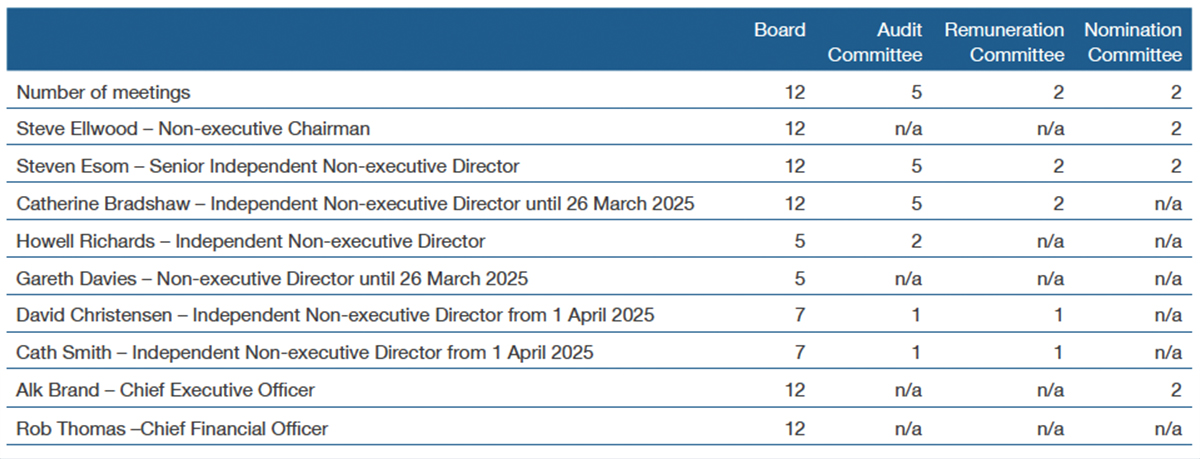


The committee composition set out below reflects the position following Steve Ellwood’s retirement as Chair and his stepping down from the Board after the 2026 AGM.


a) Remuneration Committee | b) Audit & Risk Committee | c) Nomination Committee


(The Remuneration Committee)

  • Catherine Bradshaw, Senior Independent Non Executive Director, Committee Chair
  • Steven Esom, Chairman
  • Cath Smith, Independent Non Executive Director (joined 26 June 2025)
  • David Christensen, Independent Non Executive Director (joined 26 June 2025)

(The audit committee)

  • Catherine Bradshaw, Senior Independent Non Executive Director, Committee Chair
  • Steven Esom, Chairman
  • Cath Smith, Independent Non Executive Director (joined 26 June 2025)
  • David Christensen, Independent Non Executive Director (joined 26 June 2025)

(The Nomination Committee)

  • Steven Esom, Chairman, Committee Chair
  • Alk Brand, CEO
  • Catherine Bradshaw, Senior Independent Non Executive Director
  • Cath Smith, Independent Non Executive Director (joined 26 June 2025)
  • David Christensen, Independent Non Executive Director (joined 26 June 2025)

The Board and its sub-committees are supported by external advisors as required, who will also offer guidance in ensuring Directors maintain an adequate skill set to satisfactorily carry out their duties. All Board members are able to call on the Company Secretary to arrange any required training, briefings or practical experience necessary to improve their understanding of the business and its operating environment and their obligations as directors. The Company Secretary also co-ordinates an induction process for all new directors.


The Board recognises the importance of diversity and seeks to improve the representation of female directors, when possible, as well as the importance of periodically refreshing the makeup of the Board. During the year, a second female director was appointed to the Board. A selection of Board diversity indicators is shown on page 59. In line with the Quote Companies Alliance (“QCA”) Corporate Governance Code, all shareholders will be given the opportunity to vote on the (re)-election of all individual directors to the board.


The Board reviews the independence of each Non-executive Director on an annual basis and considers that, throughout the year, all Non-executive Directors were independent, with the exception of Gareth Davies, who served as a Non-executive Director during his contractual notice period following his step-down as Chief Executive Officer and was therefore not regarded as independent.


This independence assessment was based on the criteria of length of board tenure, size of shareholding, prior and/or commercial or contractual relations with executive directors and significant inventive pay arrangements beyond a directors’ fee.


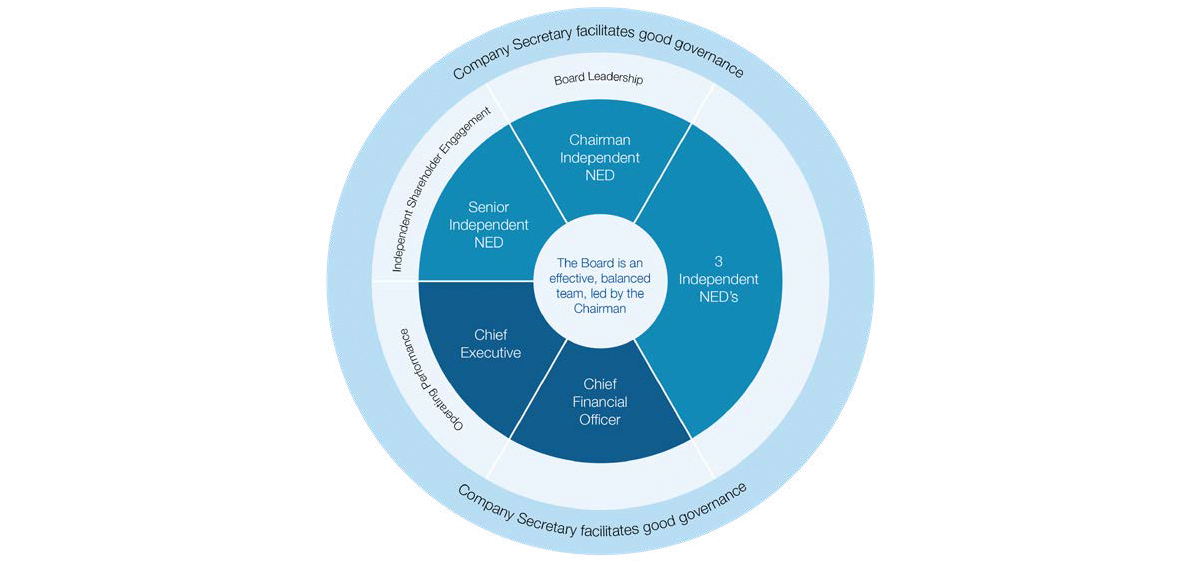
The roles of Chairman and Chief Executive Officer are separated and clearly defined. The role description of the Company Secretary includes specific responsibilities to assist the Chairman, and the other Directors, to uphold corporate governance, and to continually seek on-going improvements. On matters of corporate governance, the Company Secretary has an open reporting line to the Chairman. In addition, the Senior Independent Nonexecutive Director, Steven Esom, has considerable experience of governance, including as Chair of Sedex, a global supply chain consultancy focused on environmental, social and governance outcomes.

Biographical details of the directors and their skills are included on pages 58 – 59. The executive directors have considerable experience in the agricultural supply industry, providing a significant degree of management continuity. The non-executives bring a range of business and commercial expertise to the Board, including direct agriculture and specialist merchanting experience. Catherine Bradshaw is Audit Committee Chair and has considerable and relevant financial oversight and reporting experience in her executive role as Director of Group Reporting and Control at Cranswick plc. The Board is satisfied that it has an appropriate balance of sector, financial and public markets skills and experience and is not dominated by any one person or group of people.

As Chairman, I am responsible for leading the periodic performance reviews of the Board, its committees and the Non Executive Directors. Stakeholder feedback is sought and considered as part of this process, and I, together with our Senior Independent Non-Executive Director, Steven Esom, routinely make ourselves available to engage with shareholders.


During the financial year, the Board commenced an externally facilitated Board Effectiveness Review, conducted by Board Excellence, an independent governance advisory firm. The review has assessed the effectiveness of the Board and its committees, the quality of debate and decision-making, and the Board’s ability to support the Group through a period of significant operational and strategic transition. The review concluded January 2026.


Feedback from the review has been constructive and balanced. It recognises that Board members are highly professional, committed and engaged, with a strong focus on results and effective oversight of the Group’s financial and operational turnaround. The review also acknowledges that the Board is successfully navigating a period of significant change as the Group transitions from transformation into its next phase of growth.


The review has also identified a number of areas for further development to support the Board as the strategy evolves. These include increasing time devoted to horizon scanning and longer-term strategic thinking, strengthening the Board’s focus on risk management, and introducing greater formality in certain aspects of governance.


In parallel, the Board has continued to refresh its composition through a planned and orderly succession process, with changes announced alongside the FY25 results and proposed for approval at the forthcoming AGM. These changes support the continued effectiveness of the Board by ensuring an appropriate balance of skills, experience and independence.


The Board is currently considering the findings of the external review and will agree a programme of actions during FY26. Progress against these actions will be monitored and reported as appropriate, reflecting the Board’s commitment to continuous improvement in governance and effectiveness.

Details of the Company’s remuneration policy is included in the Directors’ Remuneration Report on pages 69 – 75. The format of this report includes simple tables showing aggregate emoluments for each director in the year ended 31 October 2025 and a projection for the year ended 31 October 2026. The format is provided to assist shareholders casting an ‘advisory vote’ on the Directors’ Remuneration Report at the AGM.

Key shareholder engagements during the year (www.wynnstayplc.co.uk)


The Senior Independent Non-executive Director is Steven Esom who makes himself available to shareholders who may require independent Board contact. Enquiries can be emailed to [email protected].