
Our History
Founded in 1917 as a farmers’ co-operative in Mid Wales, Wynnstay was built on a simple but powerful principle: supporting local farming communities through collaboration and fair access to supplies. Early investment in infrastructure, including its first depot in 1922 and the Llansantffraid mill in 1931, established expertise in animal nutrition and agricultural inputs that underpinned decades of growth. Through the mid-20th century, Wynnstay evolved alongside modern farming practices, becoming a specialist agricultural partner before achieving PLC status in 1992 and an AIM listing in 2004, providing a platform for long-term expansion. Acquisition-led growth transformed the business into a diversified UK agricultural supplies group. Today, with over a century of heritage, Wynnstay continues to look forward — guided by Project Genesis and Wynnstay Strategy Genesis, focused on sustainable growth, resilience, and supporting the agriculture of tomorrow.
Building on the operational foundation established through Project Genesis, the Group launched Wynnstay Strategy Genesis at the beginning of 2026, its five-year growth plan focused on the next phase of the Group's strategic and financial progress. With a strengthened balance sheet, disciplined governance framework and diversified revenue base, the Group remains well-positioned to support modern agriculture in a rapidly evolving market, responding effectively to ongoing market change while maintaining resilience through the agricultural cycle.
Integration of the agricultural raw materials trading operations of Wynnstay, Glasson Grain, and GrainLink into a single unit operating under the GrainLink brand. As part of Wynnstay’s Project Genesis transformation programme, this integration brings together expertise from all three teams. Trading up to 1.5 million tonnes of feed raw materials annually, the merged business strengthens market presence, enhances procurement capabilities, and supports long-term growth.
Once home to the Station Grill restaurant, the building has been transformed into a modern hub for collaboration, innovation, and efficiency. It marks a major investment in the company’s future, and is a symbol of the company’s continued commitment to farmers and rural businesses.
Glasson Fertilisers Expands with 65,000-tonne New Blending Facility at Avonmouth The new facility is central to expanding Glasson Fertilisers’ presence across the South West, Southern England, and South Wales. With advanced blending and handling technology, it delivers consistent product quality, supports strong environmental performance, and allows for future growth in capacity.
Wynnstay delivered a strong financial performance and continued to invest in operational efficiency with the launch of Project Genesis, a three-year plan that will drive higher margins, profits and cash generation. The design phase of the Project was completed during FY25, streamlining internal operations and structural efficiency.
Wynnstay strengthened its position as a leading agricultural supplies group through further expansion of its manufacturing activities and further acquisitions including S G Deakins and Tamar Milling in 2024. In October 2024, the Group welcomed Alk Brand as its new Chief Executive Officer to lead the next stage of the Group’s development.
With the company’s 100-year centenary in 2018, the Group continued to expand its geographic reach and customer base in the sector. Wynnstay made multiple acquisitions over this period, including the acquisition of eight former Countrywide Farmers stores (2018), increasing the Group’s total store network to 51.
Over the following decade, Wynnstay accelerated its growth through targeted acquisitions and organic investment. The Group expanded its feed manufacturing operations, enhanced fertiliser blending capacity, expansion into retail, pet supplies, building development, and joint ventures. This strengthened the company’s rural retail network, always staying true to its roots. This included the acquisition of Glasson Grain (2006), Youngs Animal Feeds (2009), purchase of shares in Bibby Agriculture Ltd (2005) and a joint venture with Total Angling (2007). GrainLink was also established in 2011. These moves broadened Wynnstay’s geographic coverage and deepened its product capability.
A significant milestone in the Group’s evolution, Wynnstay became a publicly listed company in 2004. Admission to AIM strengthened the company’s access to capital, enhanced governance structures and provided a platform for disciplined, long-term growth while maintaining its agricultural heritage.
The company changed its name to Wynnstay Group.
The 1990s marked a period of modernisation and commercial focus. In 1992, Wynnstay became a PLC, invested in manufacturing capability, supply chain efficiency and regional expansion. This laid the groundwork for a more scalable and diversified operating model.
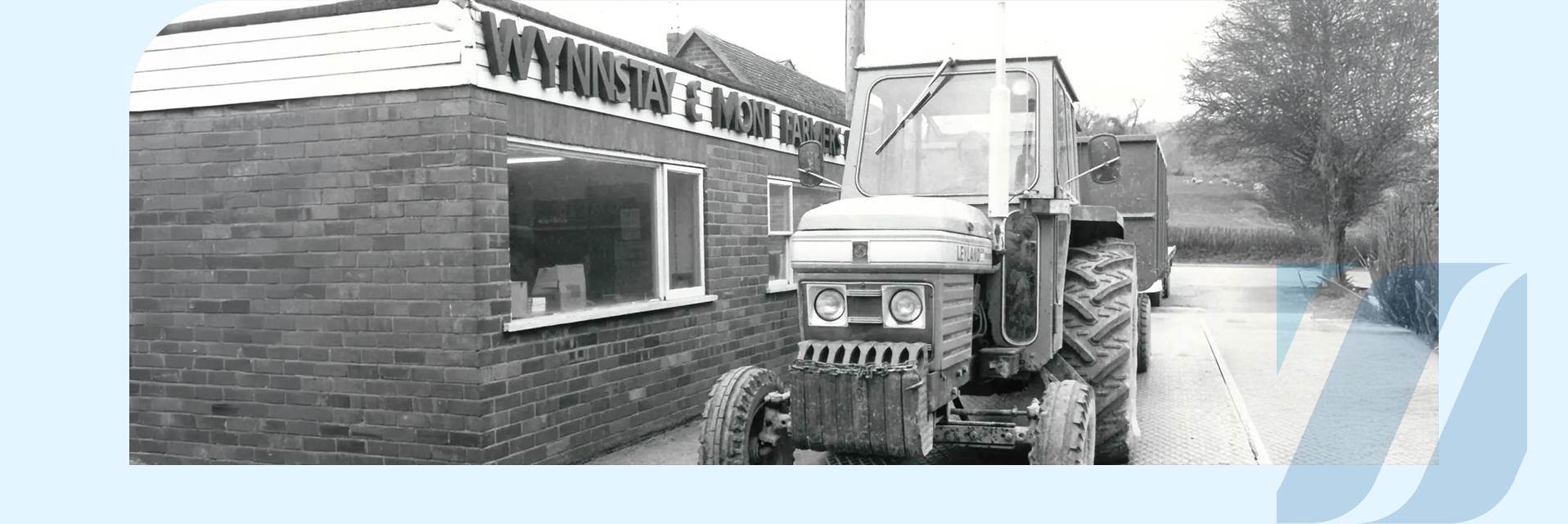
In 1963, the Society became Wynnstay and Montgomeryshire Farmers Limited. With farming becoming more mechanised and productivity-driven, Wynnstay broadened its product range and invested in infrastructure. The business developed deeper technical expertise in animal nutrition and arable inputs, positioning itself as more than a merchant, but a specialist agricultural partner. In 1981 Prince Charles visited Llansandffraid to open the refurbished mill, which was the most modern mill in Europe at the time.
During the early decades, the company’s first depot (1922) and mill (1931) were opened as Wynnstay expanded its supply network and strengthened relationships with farming communities. As agriculture modernised after the Second World War, the business adapted to meet increasing demand for feed, fertiliser and crop inputs.
Wynnstay was established as a farmers’ co-operative by tenant farmers of the Wynnstay estate in Mid Wales. Created to secure fair access to agricultural supplies and improve purchasing power, the business was founded on collaboration, mutual benefit and local trust. The first General Manager of the Society was appointed, Mr Joseph Henry Dowle.
In the village of Llanfechain, Sir Watkin William Wynn and fellow landowners gathered to address the needs of the local farming community. Their vision led to the formation of a committee, and by 1917, the Wynnstay co-operative was born, uniting tenants and landowners in a shared mission to strengthen agriculture in Mid Wales.